
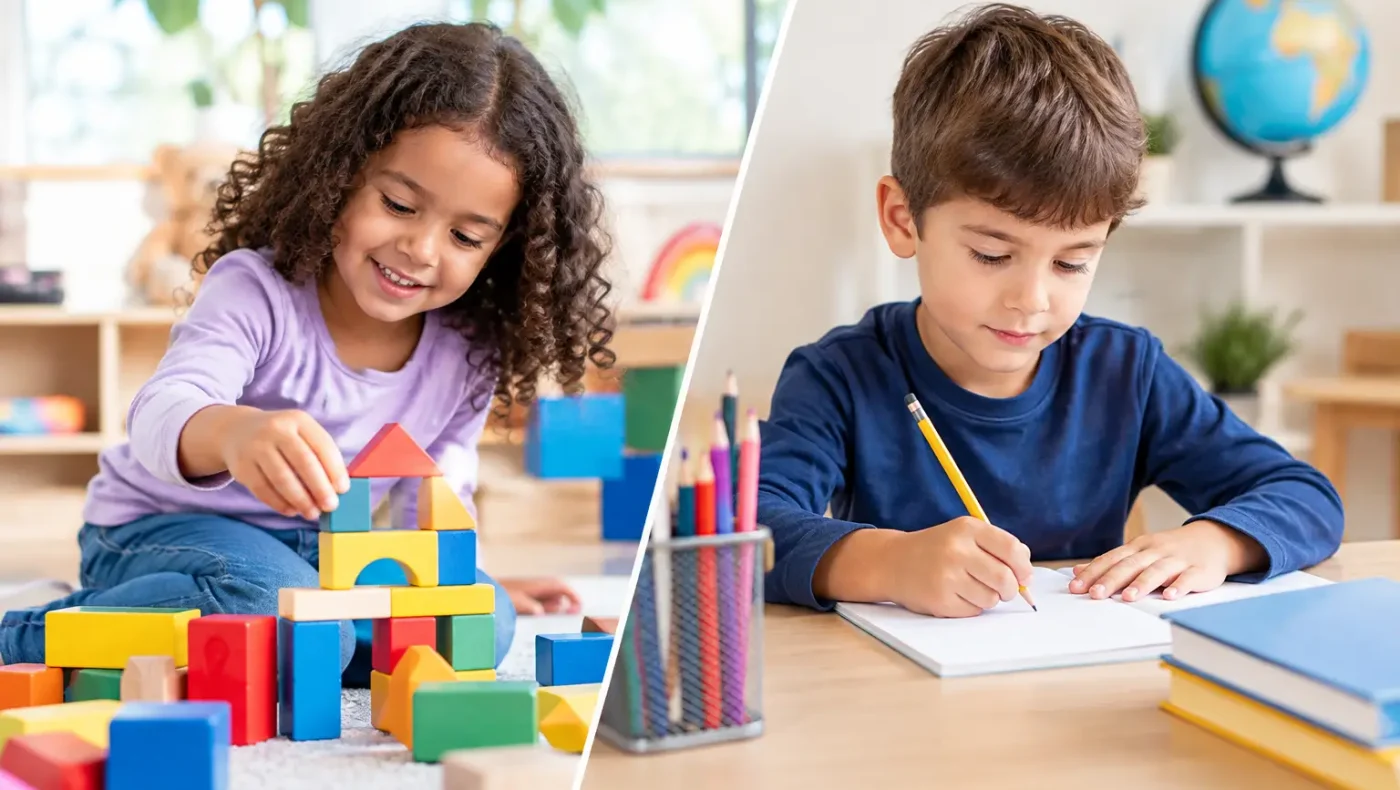
A child who can recite the alphabet but avoids books is not necessarily ahead. A child who spends an hour building a pretend shop, negotiating roles and counting play money is not simply “playing” either. For parents weighing play based vs academic preschool, the real question is not which label sounds more impressive. It is whether a preschool experience develops the skills that make learning enjoyable, purposeful and sustainable.
In Singapore, the pressure can begin early. Parents understandably want their children to enter Primary 1 ready to read, write, listen, follow instructions and manage a classroom routine. Yet readiness is bigger than worksheets or early drilling. It includes attention, language, memory, emotional regulation, curiosity and the confidence to try when an answer is not obvious.
Play Based vs Academic Preschool: The Real Difference
A play-based preschool uses purposeful activities, stories, movement, sensory materials and social interaction to help children learn. Children may explore letter sounds through games, build number sense while sorting objects, or develop vocabulary during imaginative play. The teacher’s role is active: observing, extending language, asking thoughtful questions and guiding each child towards a learning goal.
An academic preschool places more emphasis on structured teaching. There may be phonics lessons, handwriting practice, early mathematics activities and teacher-led tasks completed at tables. A strong academic setting can give children useful exposure to routines and foundational knowledge, particularly when instruction is developmentally appropriate.
The difference is not that one approach teaches and the other does not. Both should teach. The difference lies in how children are expected to learn, practise and demonstrate what they know.
The concern arises when either model is taken to an extreme. Play without intentional teaching can leave gaps in early literacy or numeracy. Academic work that is too formal, too repetitive or too advanced can turn learning into a performance children fear getting wrong. Young children need both structure and space to explore.
Why Early Learning Needs More Than Early Worksheets
A preschooler’s brain is still developing the executive functions that support later academic achievement. These include working memory, attention control, flexible thinking, planning and self-regulation. They are not optional extras. They influence whether a child can listen to multi-step instructions, persist with a reading task, organise materials and recover from frustration.
Play creates natural opportunities to practise these skills. During a block-building activity, a child plans, tests an idea, notices what has gone wrong and tries again. In a group game, they wait for a turn, remember rules and manage disappointment. During storytelling, they follow a sequence, predict an outcome and connect new words to their own experiences.
These moments may look informal, but they are intellectually demanding. When adults guide them well, they become powerful learning experiences.
This does not mean preschool children should never sit for a focused activity. They need to learn how to attend to a teacher, hold a pencil comfortably, recognise sounds in words and complete a short task. The key is dosage. A five-year-old benefits from manageable, engaging challenges that build confidence. Long, repetitive worksheets rarely teach perseverance when a child is simply overwhelmed or disengaged.
What Primary 1 Readiness Actually Looks Like
Parents often hear that a child should be “academically ready” for Primary 1. It is sensible to seek clarity about what that means. Genuine readiness is not measured only by how many sight words a child can memorise or how quickly they can complete a page of sums.
A child is better prepared when they can communicate needs clearly, understand and follow classroom instructions, recognise basic sound-letter relationships, and enjoy listening to and talking about stories. They should have early number sense, such as counting reliably, comparing quantities and recognising simple patterns. They also need practical independence: opening a lunchbox, packing belongings, taking turns and asking for help appropriately.
Most importantly, they need a healthy relationship with learning. Primary school brings new expectations. A child who believes mistakes are embarrassing may withdraw when work becomes harder. A child who has learnt that effort, strategy and practice matter is more likely to remain engaged.
The danger of confusing acceleration with readiness
Knowing Primary 1 content before entering Primary 1 can look reassuring. However, acceleration is not always the same as understanding. A child may memorise addition facts yet struggle to explain what numbers represent. They may copy sentences neatly but have little confidence generating their own ideas.
Early exposure can be valuable when it is playful, paced carefully and connected to real understanding. It becomes less helpful when it replaces sleep, movement, conversation, imaginative play or the chance to develop at an age-appropriate pace.
When a More Academic Preschool Can Be Helpful
A structured academic approach is not automatically harmful. Some children enjoy clear routines, focused lessons and the satisfaction of seeing visible progress. Children who have had limited exposure to books, English language conversation or number activities may benefit from explicit, carefully scaffolded teaching.
The quality of teaching matters more than the label on the school. Look for educators who explain concepts in more than one way, use meaningful examples and notice when a child is merely repeating an answer. Strong teachers adapt the level of challenge. They do not mistake silence for concentration or speed for mastery.
For older preschoolers, short and purposeful practice can also help build stamina for the transition to formal schooling. The aim should be to develop familiarity with learning routines, not to recreate a primary school classroom years too early.
What a Balanced Preschool Experience Looks Like
The most effective early years programmes usually blend guided play with explicit instruction. A teacher might introduce a letter sound directly, then reinforce it through a treasure hunt, picture cards, a story and a simple writing activity. A mathematics lesson may begin with counting real objects before children practise representing quantities on paper.
This approach respects how young children learn while ensuring key foundations are not left to chance. It also makes assessment more meaningful. Rather than judging a child only by a finished worksheet, teachers can observe how they explain an idea, approach a problem, respond to feedback and work with others.
Parents can look for four signs of balance: children are engaged rather than merely compliant; teaching goals are clear; activities involve language, movement and hands-on exploration; and children receive support without adults completing every task for them.
A preschool environment should feel warm and energetic, but it should also have purposeful routines. Children need freedom within boundaries. They need adults who make learning feel safe enough to attempt, and challenging enough to grow.
Questions to Ask Before Choosing a Preschool
During a school visit, move beyond asking whether children learn phonics or complete worksheets. Ask how teachers support a child who is reluctant to participate, how they extend a child who is ready for more challenge, and how they communicate progress to families.
It is also worth asking how the school develops attention, social skills and independence. These areas are sometimes discussed as separate from academics, but they directly affect academic progress. A child who can settle, listen and recover after a mistake is in a far stronger position to benefit from instruction.
Observe the children if possible. Are they speaking freely and using rich language? Are they absorbed in activities? Do teachers ask questions that invite thinking, rather than only expecting one correct response? Are there books, manipulatives, art materials and opportunities for physical movement alongside structured learning tasks?
No preschool will be perfect for every child. A quieter child may thrive in a calm, predictable setting. A highly active child may need more movement and sensory exploration. The right choice is one that understands your child while still helping them grow beyond what feels easy.
Supporting Learning at Home Without Adding Pressure
Home does not need to become another classroom. The strongest support often comes through small, consistent moments: reading together, talking about a child’s day, noticing letters on signs, measuring ingredients while cooking and playing games that involve turn-taking or memory.
When children make mistakes, resist rushing in with the answer. Try asking, “What could you try next?” or “Tell me how you thought about that.” This builds the habit of thinking, rather than dependence on adult approval.
If your child needs additional support in early literacy, numeracy, focus or confidence, seek programmes that combine clear academic goals with age-appropriate, engaging methods. At ILLAC, this means building the learning behaviours behind results: attention, memory, reasoning and the confidence to keep trying.
The best preschool choice is not the one that makes a child look advanced for a few months. It is the one that helps them arrive at school curious, capable and ready to learn with confidence.