
A child can complete ten multiplication questions correctly and still freeze when a word problem asks which operation to use. That gap is where maths reasoning matters. Parents looking at how to improve maths reasoning are not simply trying to raise a test score. They are helping their child learn to interpret information, choose a sensible strategy and explain why an answer works.
Reasoning is what turns maths from a set of rules to remember into a subject a child can navigate independently. It supports performance in school assessments, problem sums, PSLE-style questions and later algebra, but it also protects confidence. When children know how to think through an unfamiliar question, they are less likely to panic when the numbers or wording change.
What maths reasoning really involves
Maths reasoning is the ability to make sense of a problem before calculating. A strong reasoner notices relationships, identifies relevant information, represents ideas clearly and checks whether an answer is realistic. They can explain their thinking using numbers, diagrams, words or mathematical statements.
For example, a child may know that 48 ÷ 6 = 8. Reasoning begins when they can see that 48 sweets shared equally among six children means eight sweets each, or use the related fact that 6 × 8 = 48 to check their work. The calculation is important, but the connection is what makes the knowledge usable.
This is also why more worksheets do not always solve the problem. Repeating a familiar question can build speed, which has value. Yet if every question follows the same pattern, a child may learn to search for a cue rather than understand the mathematics. Progress comes from balancing fluency practice with carefully chosen questions that require explanation and choice.
How to improve maths reasoning: start with the thinking gap
Before introducing extra practice, find out where your child gets stuck. A wrong answer is useful information when you look beyond the final number. Ask your child to talk through what they believed the question was asking and what they did first. Keep your tone calm and curious. “Show me how you saw it” is more helpful than “Why did you do that?”
Some children struggle to read the language of word problems, especially words such as altogether, difference, each, remaining or at least. Others understand the question but have weak number facts, so their working memory is consumed by calculation. A third group rushes, overlooks a condition, or gives up when the first method does not work.
These difficulties need different support. Vocabulary can be taught directly, number facts can be strengthened in short regular sessions, and impulsive work benefits from routines that slow the child down. This is where executive skills such as attention, working memory and self-monitoring become closely tied to maths achievement.
Ask questions that reveal, rather than give, the method
When a child is stuck, it is tempting to demonstrate the solution immediately. This may get homework finished, but it can unintentionally teach dependence. Instead, use questions that return the thinking to the child.
Ask what information is known, what needs to be found and which detail may not matter. Encourage them to estimate the likely size of the answer. For a multiplication question, ask whether the answer should be larger or smaller than the numbers given. For a fraction question, ask what one whole represents.
Follow up with “How do you know?” and “Can you show that another way?” These prompts make reasoning visible. At first, a child may only say, “Because I just know.” Accept that as a starting point, then help them add precision: “Which number fact helped you know?” The goal is not a polished explanation every time. It is the habit of connecting an answer to evidence.
Make problems visual before making them formal
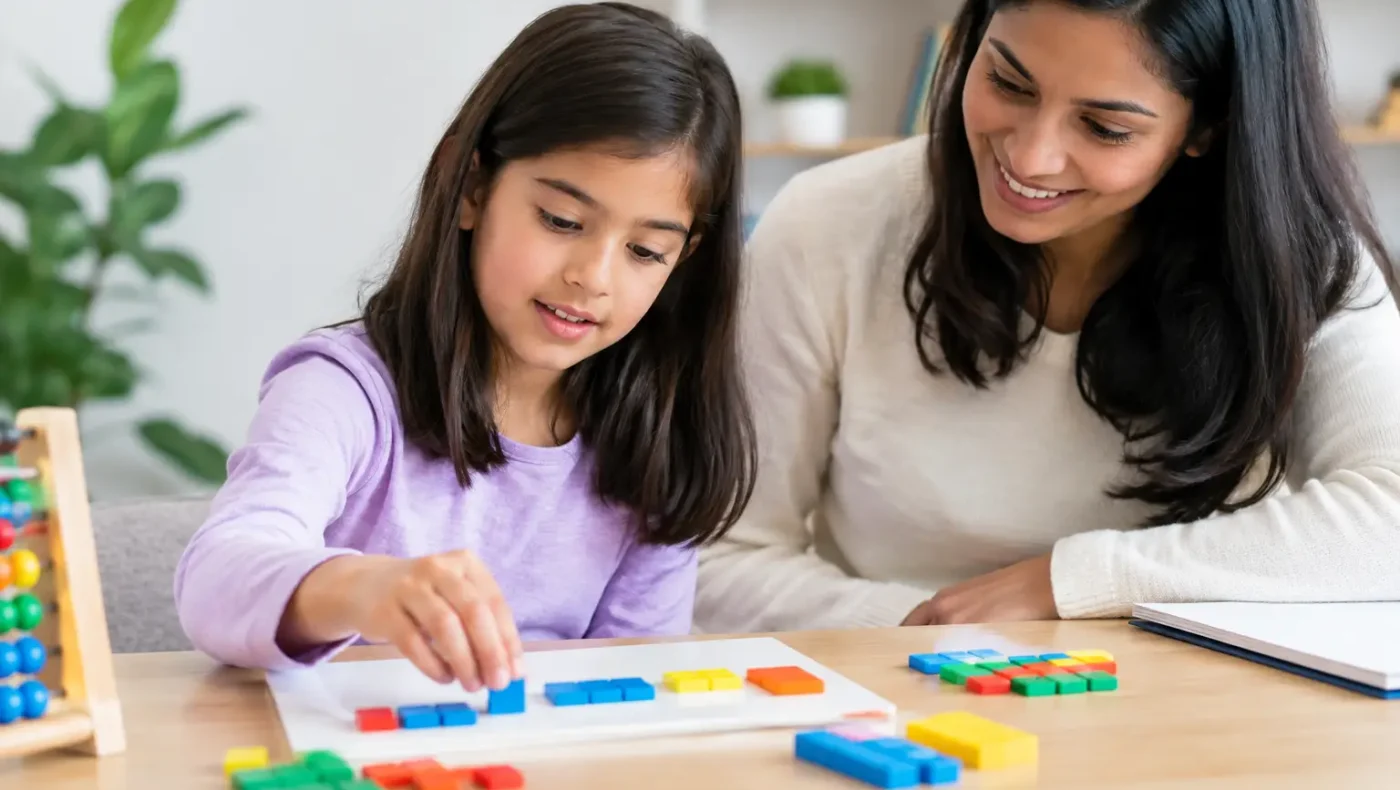
Children often reason better when they can see the structure of a problem. Bar models, number lines, counters, fraction strips, simple sketches and tables reduce the burden on working memory. They are not signs that a child is behind. Used well, they are tools for moving from a concrete situation to an abstract equation.
Take this question: “There are 36 pupils. Twice as many girls as boys are in the class. How many boys are there?” A child who writes 36 ÷ 2 may be guessing at the operation. A child who draws one equal bar for boys and two equal bars for girls can see three parts in total. The model makes the relationship clear, leading to 36 ÷ 3 and then the number of girls.
As confidence grows, encourage the child to decide which representation is most useful. Drawing every problem can become slow in an exam. The aim is flexible thinking, not reliance on one format.
Use variation, not just volume
A powerful way to build reasoning is to place similar-looking questions side by side and ask what changes. For instance, compare 24 sweets shared among six children with 24 sweets packed into bags of six. Both involve division, but one asks for the number in each group and the other asks for the number of groups.
This small shift teaches children to read for meaning rather than hunt for an operation. You can also change a condition in a question and ask whether the answer increases, decreases or stays the same before calculating. Predicting first strengthens number sense and gives the child a way to spot unreasonable answers.
Include questions with more than one possible method. A child might solve 19 + 36 by adding 20 and subtracting one, or by partitioning tens and ones. Discussing efficient methods is valuable, but avoid presenting one approach as the only acceptable route when another is correct and clearly explained.
Build a checking routine that children can use alone
Reasoning does not end when the child reaches an answer. High-performing learners regularly check whether their solution fits the question. A simple routine is to read the question again, estimate, calculate, and check using an inverse operation, a model or a different method.
For example, after solving 84 ÷ 7 = 12, the child can check 12 × 7 = 84. After finding the cost of three items at $8.90 each, they can estimate that the total should be close to $27, not $267. This routine is especially useful for children who lose marks through careless errors despite understanding the topic.
It should be taught patiently. Telling a child to “check your work” is vague. Showing them exactly what to check, and praising a corrected error as evidence of good mathematical habits, makes self-monitoring more likely to stick.
Create short, purposeful practice at home
Reasoning develops through frequency, but lengthy sessions can create resistance. Ten to fifteen focused minutes several times a week is often more productive than one exhausting weekend worksheet. Begin with one or two familiar questions to settle attention, then include a problem that requires explanation or a new representation.
Use everyday moments when they arise. Ask a younger child how many more plates are needed for dinner, or ask an older child to compare discounts and explain which offer is better value. The point is not to turn every family activity into a lesson. It is to show that maths describes decisions and relationships beyond the page.
Praise process with specificity. Rather than saying only “You are clever”, notice that your child drew a diagram, checked an estimate or tried a second method. This builds the confidence to persist through challenge. It also helps children separate a difficult question from a fixed belief that they are “not good at maths”.
When extra support can make a difference
If your child repeatedly cannot explain their method, avoids problem sums, or understands lessons but performs poorly under timed conditions, targeted support may be worthwhile. The most effective help does more than reteach procedures. It identifies whether the barrier is conceptual understanding, language, number fluency, focus or exam strategy.
At ILLAC, maths instruction is designed alongside executive function development, helping students strengthen the focus, working memory and critical thinking that complex questions demand. In a small-group setting, an educator can observe a child’s method closely, correct misconceptions early and create opportunities to explain their reasoning without the pressure of giving the fastest answer in class.
Improvement is rarely about finding a clever shortcut. It comes when a child has repeated chances to pause, represent a problem, justify a decision and learn from an error. Give them that space consistently, and the confidence they carry into the next unfamiliar question can become just as valuable as the answer itself.