
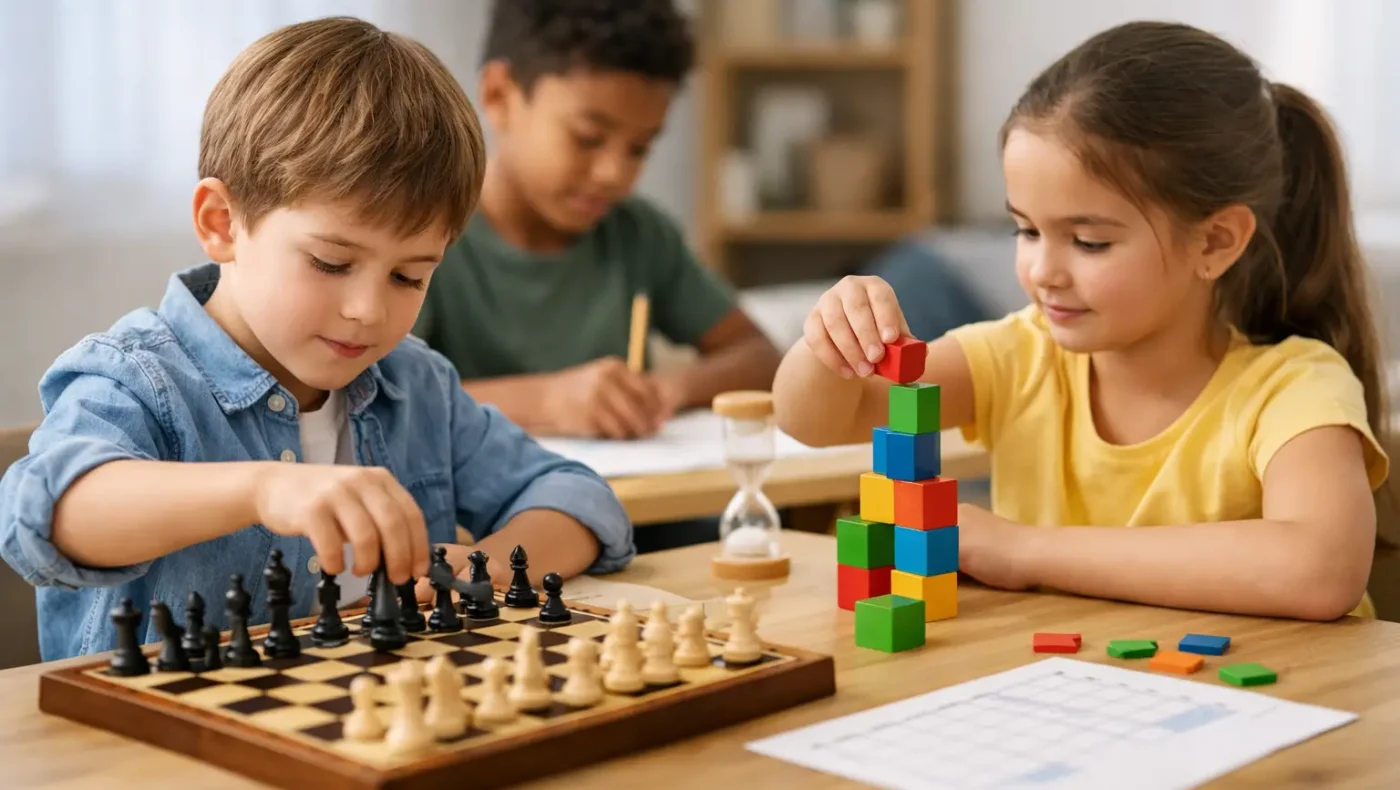
A child who knows the answer but still forgets to bring the worksheet, loses track midway through homework, or rushes through careless mistakes is not lacking ability. More often, the missing piece is executive function. That is why the best executive skills activities are not just extra games to fill time. They strengthen the mental processes that help children focus, plan, remember instructions, manage emotions, and follow through.
For parents, this matters because executive skills sit underneath almost every academic outcome. A child may have good content knowledge in English, Maths, or Science, but if they struggle to start tasks, stay organised, or shift attention appropriately, results often stay inconsistent. The right activities can help, but only when they are chosen with purpose.
What makes executive skills activities actually effective?
Not every puzzle, app, or classroom game builds executive function in a meaningful way. The strongest activities challenge a child to hold information in mind, control impulses, adjust to new rules, and work towards a goal. They should feel engaging, but there must also be a clear cognitive demand.
This is where many well-meaning approaches fall short. If an activity is too easy, it becomes entertainment. If it is too hard, children become frustrated and disengage. The sweet spot is a task that stretches the brain just enough for effortful thinking. Over time, that repeated effort is what improves working memory, attention control, planning, and mental flexibility.
Age matters too. A preschool child needs very different practice from a Secondary student. Younger children benefit from movement, visual cues, rhythm, and short bursts of challenge. Older students need tasks that reflect real academic pressure, such as planning revision, prioritising homework, or monitoring careless errors under time limits.
10 best executive skills activities that build real learning habits
1. Rule-switching games
Games where the rules suddenly change are excellent for cognitive flexibility. A child might sort cards by colour first, then by shape, then reverse the rule entirely. This forces the brain to pause, inhibit the old pattern, and apply a new one.
That matters in school more than parents often realise. It is the same skill children use when a Maths question changes format, when a comprehension passage requires a different reading strategy, or when a teacher gives multi-step instructions that cannot be done on autopilot.
2. Memory tray challenges
Place several items on a tray, allow a child to study them briefly, then cover the tray and ask what they remember. To make it more demanding, ask them to recall in categories, in order, or after a short distraction.
This is a simple way to train working memory. It helps children hold and manipulate information, which is essential for mental sums, sentence construction, note-taking, and following classroom instructions.
3. Timed planning tasks
Give a child a small goal such as packing a school bag, preparing materials for tuition, or organising the steps for a project. The key is not speed alone. Ask them to think first, sequence the task, and then carry it out.
Planning is one of the most overlooked executive skills. Many children are told to be more organised without being taught how. Activities like this make planning visible. Parents can observe whether the child acts impulsively, misses steps, or improves when given a checklist.
4. Inhibition games
Classic stop-start activities remain effective because they train impulse control. Think of tasks where children must freeze, wait for a cue, or respond only when a specific signal appears. Even simple variations can become powerful when the pace increases.
Impulse control affects classroom behaviour, test accuracy, and emotional regulation. A child who learns to pause before acting is more likely to check work carefully, listen fully to instructions, and avoid preventable mistakes.
5. Pattern replication and sequencing
Ask children to copy increasingly complex patterns using blocks, shapes, sounds, or movements. Then move beyond copying and ask them to predict what comes next or create a pattern from a rule.
These activities support sequencing, attention, and reasoning. For younger learners, this helps with literacy and numeracy foundations. For older students, the same mental discipline supports algebraic thinking, written expression, and structured problem solving.
6. Delayed gratification exercises
Not every executive skills activity has to look academic. Tasks that ask a child to wait, save points for a bigger reward, or complete a less preferred task before a preferred one are valuable. They train goal-directed persistence.
This is especially useful for children who know what they should do but give up quickly when effort is required. Delayed gratification connects directly to revision stamina, homework completion, and resilience when tasks feel challenging.
7. Multi-step listening games
Give two-step, three-step, or four-step oral instructions and ask the child to complete them accurately without repetition. You can increase difficulty by adding movement, location changes, or distracting elements.
This targets listening accuracy and working memory together. In school, that translates into better task completion, fewer missed instructions, and stronger independence. Children who rely on repeated prompting often need this kind of practice more than another worksheet.
8. Error detection activities
Present a piece of writing, a Maths solution, or a sequence with intentional mistakes and ask the child to identify and correct them. This strengthens self-monitoring, which is one of the clearest differences between passive learners and independent ones.
Some children finish work quickly and assume speed equals competence. Error detection trains them to slow down, inspect details, and evaluate their own thinking. That habit often leads to immediate gains in accuracy.
9. Task initiation routines
For many families, the real struggle is not whether a child can do the work, but whether they can begin. One of the best executive skills activities is a structured start routine. This might include setting a timer for two minutes, preparing materials in order, and beginning with one very specific first step.
Task initiation is often misunderstood as laziness. In reality, many children feel mentally overwhelmed when a task appears too large. Breaking the start into a repeatable routine reduces friction and builds momentum.
10. Reflection and self-rating tasks
After an activity, ask the child what strategy worked, where they got stuck, and what they would do differently next time. Keep it short and concrete. Reflection is not about over-analysing. It is about helping children notice their own learning process.
This develops metacognition, the skill that allows students to become more independent and efficient over time. Children who can evaluate their performance are better able to adjust revision methods, manage mistakes, and improve without constant adult correction.
How to choose the best executive skills activities for your child
The best activity depends on what is currently getting in the way of performance. If your child forgets instructions, focus on working memory and listening tasks. If homework turns into a battle at the starting line, prioritise task initiation and planning. If careless mistakes are the issue, use inhibition and error-monitoring exercises.
It also depends on age and temperament. A very active child may respond better to movement-based activities, while an older student may engage more seriously when the task is linked to school outcomes. The goal is not to entertain a child into improvement. The goal is to build the underlying habits that make learning faster, calmer, and more successful.
Consistency matters more than complexity. Ten focused minutes done regularly will usually produce better results than a long session done once in a while. Parents do not need to create a boot camp at home. They need a manageable rhythm, clear expectations, and activities matched to the child’s actual needs.
Why activities alone are not always enough
Executive function can improve with practice, but progress is rarely random. Children grow faster when activities are taught deliberately, adjusted to the right level, and connected to academic demands. A memory game may help, but the real breakthrough comes when a child starts applying stronger memory skills to spelling, comprehension, or revision.
That transfer does not happen automatically for every child. Some need explicit coaching. Some need repeated modelling. Some need a more structured environment than home routines can provide. This is why high-quality executive function training often works best when it is woven into learning rather than treated as a separate add-on.
At ILLAC, this is exactly the point. We do not see focus, memory, time management, and confidence as extras. We treat them as the foundation that makes academic teaching more effective. When children strengthen these skills in a purposeful way, they often do not just study more. They study better, with less stress and more control.
Parents often ask when they should start. The honest answer is earlier than most people think, but later is still worth it. A preschooler can learn waiting, listening, and sequencing through play. A Primary pupil can build planning, working memory, and emotional control before school demands become heavier. A Secondary student can still make significant gains by improving self-monitoring, revision structure, and task persistence.
The most helpful mindset is this: when a child struggles with consistency, there is usually a skill to build, not just a behaviour to correct. Once you see that, the best executive skills activities stop feeling like extras. They become part of how you help your child grow into a more focused, capable, and confident learner.