
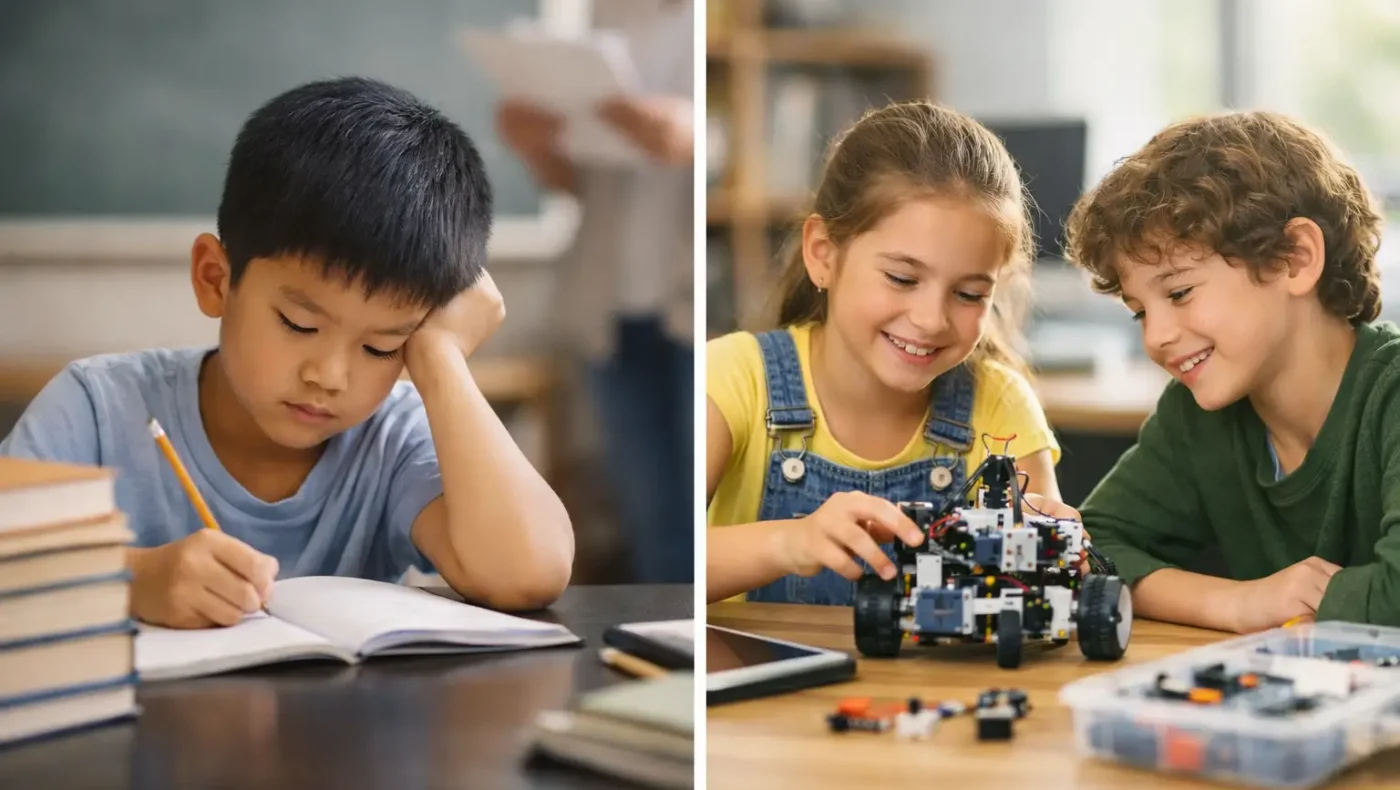
A child who can recite a model answer perfectly but freezes when the question changes is not lazy, careless, or incapable. More often, that child has been trained to remember without truly understanding. That is the heart of the rote learning vs deep learning debate, and it matters deeply for parents who want better grades without the usual cycle of stress, cramming, and forgotten content.
For many families, rote learning seems to work at first. Spelling lists get memorised. Science definitions are copied until they stick. Maths procedures are repeated often enough to survive a weekly test. The problem appears later, when school begins to demand transfer, reasoning, and independent thinking. That is usually when parents notice a gap between effort and results.
What rote learning vs deep learning really means
Rote learning is memorisation through repetition. A child practises the same fact, sentence, or method again and again until it can be recalled quickly. There is a place for this. Times tables, phonics patterns, formulae, and key vocabulary often do require repetition before they become automatic.
Deep learning is different. It happens when a child understands why something works, how ideas connect, and when to apply knowledge in a new context. Instead of only remembering that 3 x 4 = 12, the child understands groups, patterns, and relationships. Instead of memorising a comprehension answer, the child can infer meaning from an unfamiliar passage.
This distinction matters because schools do not assess memory alone. They assess whether students can interpret, compare, explain, justify, and solve. In other words, they assess thinking.
Why rote learning can look effective at first
Parents are not wrong to be drawn to methods that produce quick visible results. Rote practice often gives immediate signs of progress. A child can finish homework faster, score better on a short quiz, or appear more prepared before an exam.
There are three reasons for this. First, repetition reduces hesitation. Second, predictable question types reward recall. Third, memorised content can create a temporary sense of confidence. For younger learners especially, some level of repetition is useful because automatic recall frees up mental space for harder tasks.
The issue is not that rote learning is bad in every case. The issue is that it is limited. If it becomes the main way a child studies, progress usually plateaus.
Where rote learning starts to fail
The weaknesses of rote learning become obvious when children face unfamiliar questions. A Primary pupil may know the textbook definition of evaporation but struggle to explain why clothes dry faster on a windy day. A secondary student may memorise algebraic steps yet make errors as soon as the equation is presented differently.
This is also why some children seem to study for hours but still underperform. They are putting in effort, but the effort is spent on recall without processing. The knowledge stays shallow, which means it is easier to forget under pressure.
Rote-heavy learning can also affect motivation. Children often feel that studying is something done to them rather than something they can actively make sense of. Over time, that leads to frustration, avoidance, or dependence on model answers.
What deep learning looks like in practice
Deep learning is not vague or purely theoretical. In strong classrooms and high-quality tuition settings, it is highly practical. A child doing deep learning might compare two problem-solving methods, explain an answer aloud, sort examples into patterns, or connect a new idea to something already learned.
In English, deep learning means understanding tone, inference, and structure rather than memorising fixed phrases. In Mathematics, it means seeing why a method works and choosing the right strategy independently. In Science, it means linking cause and effect instead of reciting a definition without context.
When children learn deeply, they are usually better at retention as well. That may sound surprising, but understanding strengthens memory. The brain stores information more reliably when it has meaning, structure, and relevance.
Rote learning vs deep learning in exams
Many parents assume that exams reward memorisation. In reality, most strong exam performance depends on a blend of both recall and reasoning.
A student does need certain facts at their fingertips. There is no benefit in rediscovering multiplication tables during a paper, or pausing to reconstruct every grammar rule from scratch. Automaticity matters. But automaticity is only the foundation. The marks are often won by interpreting what the question is really asking, selecting the right concept, and adapting under timed conditions.
This is why deep learning tends to produce more stable results over time. Students who understand can handle variation. They are less likely to panic when a question is phrased differently. They recover more easily from mistakes because they can think through the logic instead of relying on memory alone.
For high-stakes stages such as PSLE, GEP selection support, or O-Level preparation, this difference is especially important. Children are not simply tested on whether they have seen a question before. They are tested on whether they can think.
The best approach is not all or nothing
The most effective learning is rarely a pure choice between the two. It is usually a matter of sequence and balance.
Children need some rote learning for core foundations. Number bonds, spelling patterns, subject vocabulary, formulae, and certain writing conventions do benefit from repeated retrieval. Without that base, working memory gets overloaded and higher-level thinking becomes harder.
But those basics must then be extended through deep learning. Once a child has memorised, they need to explain, apply, compare, and use the knowledge flexibly. Otherwise they end up with facts they cannot use.
A good rule for parents is simple. If your child can only answer the exact version they practised, the learning is still shallow. If they can handle a new version confidently, understanding is growing.
How parents can tell which kind of learning their child is doing
You do not need to be sitting in every lesson to spot the difference. Listen to the way your child studies and the way they respond when stuck.
A child relying mainly on rote learning often says, “I memorised it but I forgot,” or “I know the answer when I see it.” They may ask for the exact method, the exact sentence, or the exact template. When the question changes, confidence drops quickly.
A child developing deep learning sounds different. They can explain their reasoning in simple words. They ask better questions. They make connections across topics. Even when they get something wrong, they are more likely to correct themselves once prompted.
This is also where executive function plays a major role. Focus, working memory, planning, and cognitive flexibility affect whether a child can move beyond cramming. If these skills are weak, even bright students may fall back on memorisation because it feels safer and faster.
How to move a child from memorising to understanding
The shift does not require making learning more complicated. Often, it means changing the kind of practice a child does.
After your child memorises a fact or method, ask them to teach it back. Ask why it works. Ask when it would not work. Give a slightly different example and see if they can adapt. In reading, ask what clues led them to an answer. In Maths, ask whether there is another way to solve it. In Science, ask them to connect the concept to daily life.
It also helps to reduce over-reliance on copying. Copying notes can feel productive, but it often creates familiarity rather than mastery. Retrieval practice, explanation, and varied application are usually stronger.
Most importantly, watch your child’s emotional response. Deep learning should challenge children, but it should not leave them constantly lost. The right support combines explicit teaching, structured practice, and guided thinking. That is where skilled educators make a real difference.
At ILLAC, this is exactly why academic teaching is paired with memory, focus, and thinking-skills development. Children do better when they are not just fed answers, but trained to process and use knowledge with confidence.
Why this matters beyond grades
The real cost of overusing rote learning is not just lower marks on tricky questions. It is dependency. Children begin to believe they can only succeed when they are given a fixed method, a perfect model, or endless repetition. That mindset makes school feel harder every year.
Deep learning builds something more valuable – independence. A child who understands can attempt, adjust, and persevere. They are usually calmer under pressure because they trust their thinking, not just their memory. That confidence carries into class participation, homework, revision, and long-term academic growth.
Parents often come looking for better marks, and understandably so. But the deeper goal is a child who can learn well, not just score temporarily. When that shift happens, results usually follow with less struggle and far more stability.
If your child is working hard but not progressing as they should, it may not be an effort problem at all. Sometimes the real change begins when we stop asking children to remember more, and start teaching them how to understand.